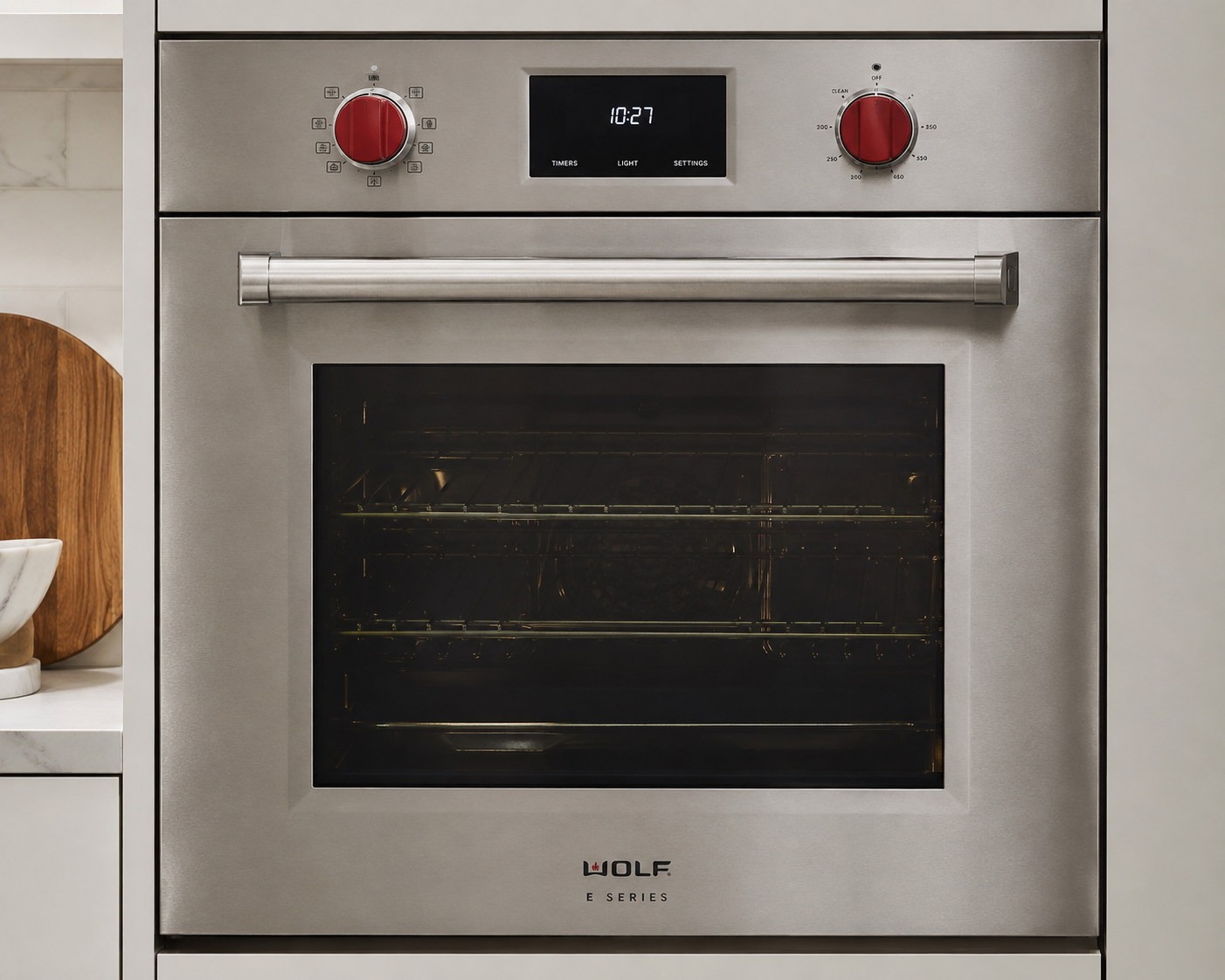
This oven is regarded as the top American appliance manufacturer (owned through Sub-Zero Group), known for commercial-grade convection with distinctive red knobs and a lifespan of over 20 years. The most powerful oven models include built-in ranges as well as wall ovens that start at $4,000 and only available at authorized retail stores. Wolf Gourmet, a companion countertop line, offers the same style and performance in smaller appliances beginning at $400. They are widely available both in-store and online.
If you’ve ever spent time exploring the latest kitchen appliances, then you’ve probably come across the word oven. With its distinctive red knobs for control and a name that dates all the way back to kitchens used in commercial settings, the Wolf oven has been a common term for serious cooking at home. But an oven really worth the cost, or is it primarily the brand’s image? This guide explains every model, including real pricing as well as reliability data and how the Wolf oven compares to competitors, so that you can make an informed decision.
What Makes a Wolf Oven Different
A typical appliance firm doesn’t manufacture the oven. Wolf started in 1934, manufacturing appliances for cooking in commercial restaurants. This DNA is evident in every modern Wolf oven. From 2000 onwards, Wolf has operated as the cooking division of Sub-Zero Group, based in Madison, Wisconsin — matching each Wolf oven to the exact high-tech standards that are used in Sub-Zero refrigeration as well as Cove dishwashers.
1.What sets apart a Wolf oven from a regular Wall oven?
The combination of two convection systems with precise temperature control and a construction designed to withstand many years of constant usage. The majority of ovens have 12-year warranties for the cooking system that is sealed, and the brand is known for its availability of spare parts even after the models are taken off the market — a feature that serious buyers are concerned about more than the appearance.
Wolf Oven Types: Built-In, Range, and Steam
This oven isn’t a single product. The range offers a variety of styles based on the kitchen’s design and cooking style.
1.Built-in wall ovens
The built-in ovens in wall units can be the most well-known oven category. They are installed directly into cabinets as double, single, or even combination units (often a combination of the standard oven with microwaves or speed ovens). An integrated oven will be your most popular option for kitchens that can have a cooktop that is separated from the oven completely. If you’re considering an option with a double layout, then our guide to the Double Oven Guide to Electric Ranges will explain how the configuration compares to other brands.
2.Range ovens
The range ovens include the cooktop and oven in one unit. The Wolf oven is offered in gas as well as with dual fuel (gas cooktop and electric oven) or induction and is the most popular option for home cooks who need everything within one space.
3.Steam ovens
Steam ovens are a less popular but increasing category. A oven that can steam is popular with cooks who are conscious of their health because steam cooking retains moisture and nutrients much better than convection heating, which is dry.
4.Speed ovens
Speed ovens complete the line with a small oven that has convection and microwave functions to provide quicker cooking but not the same quality.
Wolf Oven Series Explained: E Series vs M Series vs Transitional
Selecting the best Wolf oven series is as important as choosing the right type.
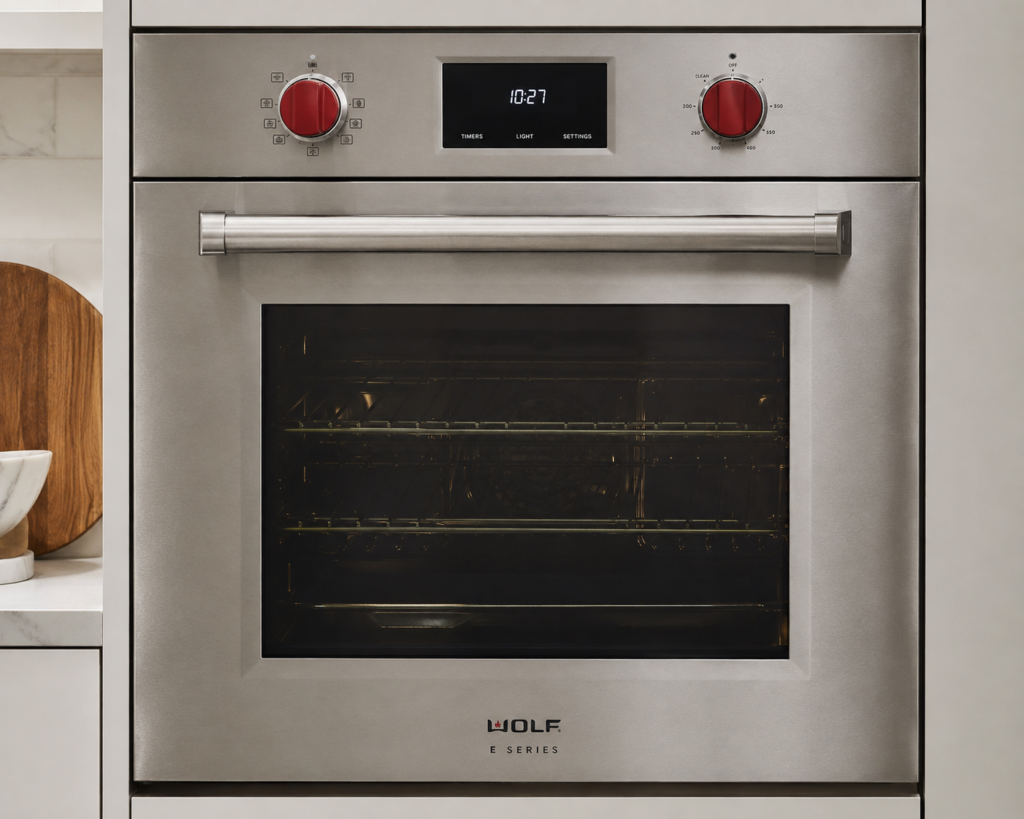
E Series
The E Series is Wolf’s most popular lineup and is the most frequently used oven line. It comes with dual convection fans and classic red knobs and has a track record of success. The E Series oven typically has multiple cooking options, a temperature gauge, and a rack that extends to the fullest extent, offering solid performance without the cost of the top line.
M Series
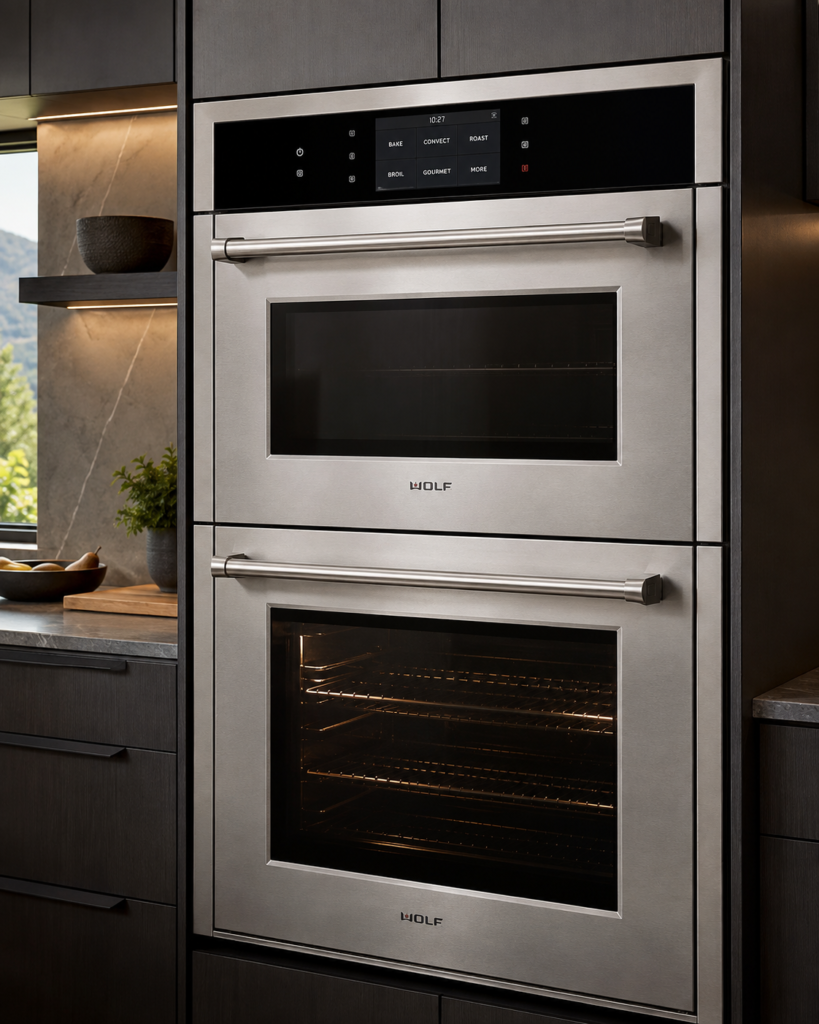
The M Series is Wolf’s most advanced model. This oven series is the first to introduce Dual VertiFlow (or Dual VertiCross on ranges) convection technology. It utilizes two fans instead of one for more uniform heat distribution. It also provides about 13% more capacity in double ovens. M Series ovens also add touchscreen controls, Wi-Fi connectivity, and the Gourmet Mode settings. Expect to pay between $1,000 and $1,500 more than an E Series oven for these features.
Transitional
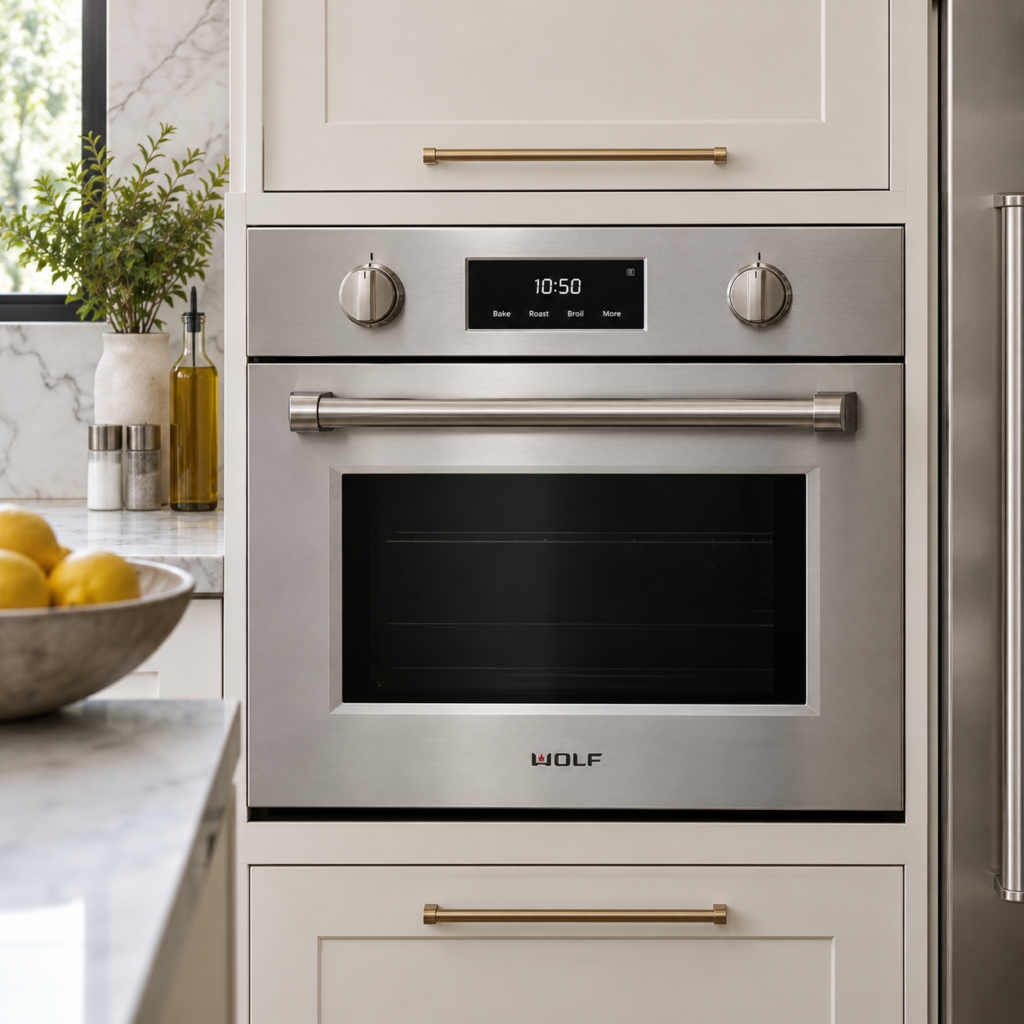
The transitional range is designed for those who prefer the most basic oven features, including convection, multiple cooking options, and touchscreen controls, in the form of a minimalist appearance. The line is also offered in smaller 24-inch sizes, which makes the Transitional oven a strong choice for kitchens with small spaces or as a second oven.
Wolf Oven Pricing: What to Actually Expect
The price is the main reason why buyers hesitate, and with valid reasons. This oven is a dependable investment.
| Wolf Oven Category | Typical Price Range | Best For |
| Single Transitional Wall Oven | $4,000-$6,000 | Kitchens with compact layouts; secondary oven |
| E Series built-in wall oven | $5,000 – $8,000 | Everyday family meal at home |
| M Series double wall oven | $8,000 – $10,000+ | Renovations that are high-end |
| 30 to 36” gas range | $6,000 – $9,000 | Classic cooking with flame control |
| Dual fuel range | $8,000 – $20,000 | Precision baking + gas cooktop control |
| Induction range | $9,000 – $17,000 | Modern, fast cooking that doesn’t require gas |
| Wolf Gourmet countertop oven | $400 – $800 | Wolf performance with a smaller budget |
The 36-inch oven can be found between $6,000 and $700 A 60-inch dual-oven range could go up to $12,000-15,000 or higher. Installation, custom finishes, as well as add-ons such as induction or a griddle could increase the price. Comparatively, the simple Transitional Wolf oven at $4,000 is the cheapest way to get into the full-size model.
Is a Wolf Oven Worth It? The Honest Case For and Against
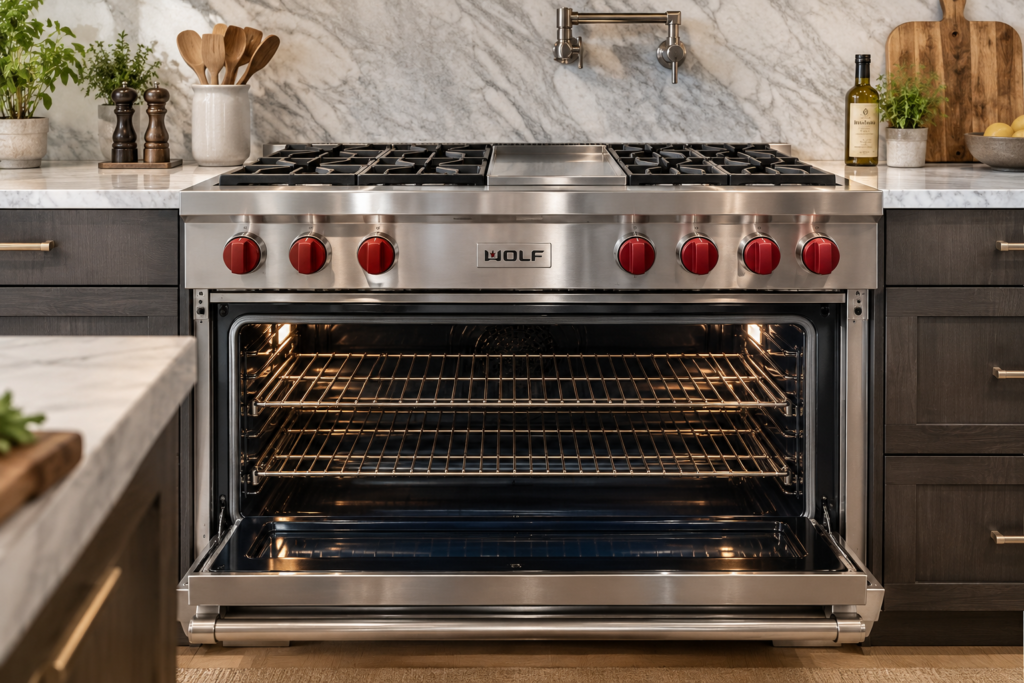
The reasons to use a Wolf oven are worth its cost:
- Commercial-grade construction built to last for more than 20 years of routine usage.
- 12-year warranty on the cooking system, sealed, and long-term parts availability.
- Technology that uses dual convection (especially M Series) delivers truly even baking results.
- Resell and renovation value that is strong oven has become a well-known feature in the listings of luxury real estate properties.
- Flexible wide-format built-in, range, steam, or speed configurations.
Where a Wolf oven might not be the best choice:
- Cooks who aren’t using advanced convection and multi-mode functions might not be able to tell the difference from an oven that’s mid-tier.
- The upfront cost is considerably more expensive than comparable models of Bosch, Whirlpool, or GE.
- Sizeful ovens are only sold through authorized dealers, which means the process of comparison shopping is more time-consuming.
- Parts and repairs, although they are available, generally require a certified technician rather than DIY fixes.
As per Homes & Gardens (established home/lifestyle authority, editorially tested Wolf Gourmet) Appliance reliability information, top-range brands generally have better longevity than budget ranges; however, repair costs are higher when repairs are required, which is also true for the oven.
Wolf Oven vs Thermador vs Miele: How It Compares
The 3 names that pop frequently in the realm of the design of a luxury kitchen are Wolf, Thermador, and Miele.
A Wolf oven usually wins in raw power and commercial-style performance. Its convection system and broiler power are made for cooks who use their ovens to the limit. Thermador is a close competitor in terms of features and usually beats Wolf in the area of smart-home integration. Miele, however, is geared towards precision engineering and a quieter, refined performance, and often comes at a higher cost than the oven.
If your primary concern is reliability, high-heat performance, and an established repair network, then oven is generally the most reliable long-term option. If features that are smart or quiet operation are important to you than the other features, you should consider comparing options prior to committing.
Wolf Gourmet: The Budget-Friendly Way Into the brand
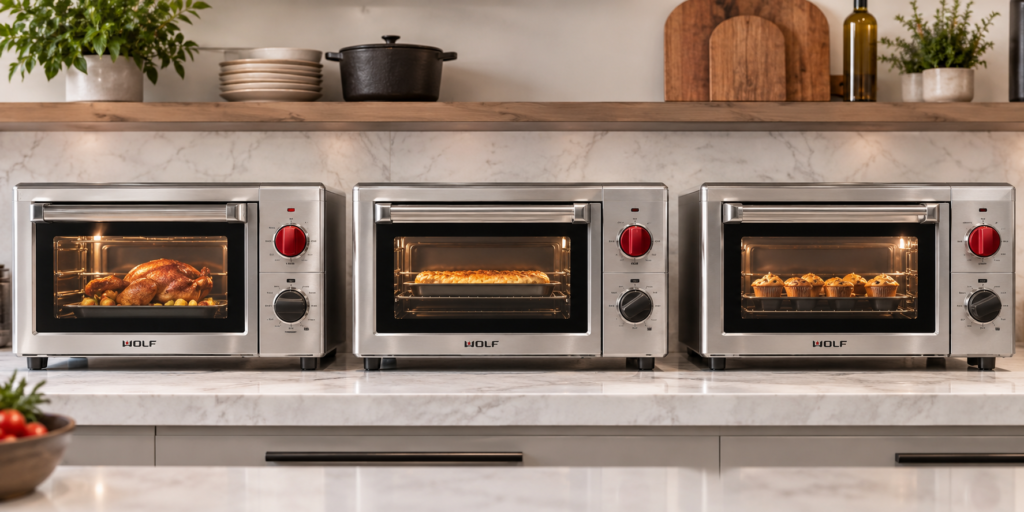
Many aren’t prepared to spend $6,000 on a range, and this is the reason Wolf Gourmet comes in. This countertop line adds the oven’s design language (yes, there are knobs in red) to toaster ovens, as well as convection ovens for countertops that are readily accessible through both in-store and online retailers.
| Model | Price Range | Key Features |
Wolf Gourmet WGCO100S Countertop Oven | ~$400 – $500 | Convection, bake/broil/roast/proof/toast/warm, red knobs |
| Wolf Gourmet WGCO150S Countertop Oven | ~$600 – $700 | Convection, bake/broil/roast/proof/toast/warm, red knobs |
| Wolf Gourmet Elite WGCO170SR Countertop Oven | ~$700 – $800 | 7 cooking modes, temp probe, interchangeable silver/black knobs, halogen interior light |
The Wolf Gourmet countertop oven won’t be able to replace a full oven range; however, it is a good option to try the high-end build quality and control accuracy before buying a built-in appliance or as an additional appliances in kitchens that includes a large oven. The majority of reviewers discuss this Elite model as working as a true second oven instead of an ordinary toaster oven because of its capacity as well as its heating capability.
How to Buy a Full-Size Wolf Oven
In contrast to many appliance brands that are available in full-size, a oven won’t be something you can find in a typical big-box retailer. Wolf is sold through a group that includes authorized dealer businesses such as AJ Madison, Abt Electronics, and regional appliance showrooms, many of which require a phone call or a store visit to determine pricing on wall ovens as well as ranges. This is done to ensure that Wolf is able to combine its sales process with expert guidance for installation because a properly installed appliance directly impacts long-term performance and warranty coverage.
Before you purchase a oven, take measurements of your current cutout with care. Choose between double- or single-cutout configurations, and determine if your kitchen requires electric, gas, or dual fuel in accordance with the utility lines you have.
Maintaining a Wolf Oven for Long-Term Performance
- This oven is designed to last for a long time, but it’s only with constant attention.
- Clean up spills immediately instead of leaving them to bake on surfaces because a sloppy residue could hinder the effectiveness of the self-clean cycle as time passes. Examine door seals regularly; a worn seal allows heat to escape and causes the oven to work harder, which can affect even an engineered oven’s performance.
- Get the sealed system checked by a qualified technician in case you experience uneven heating.
- Repairs done by you could void the warranty of an oven.
Common Wolf Oven Problems and How to Avoid Them
Even a sturdy oven can be prone to problems and knowing the signs to be looking out for could keep you from costly repairs later.
- Venting excessive heat. One of the most frequent complaints regarding an oven, particularly in small kitchens or in hot climates is that it releases an enormous amount of hot air from its bottom throughout or after cooking. Because ovens depend heavily on convection units in order to create their unique uniform heating, this venting process is an outcome of their efficiency. People living in warmer areas may discover that the oven significantly increases the temperature of their kitchen during lengthy cooking sessions. In certain instances, professional installers advise the addition of additional ventilation to counter this.
- Preheat times are slower on double ovens. Some double wall ovens, especially within the E Series, take longer to heat up than other brands usually 10-12 minutes as opposed to 6-8 minutes for competitors like Miele and Thermador. It’s not a flaw but a compromise for the more dense insulation and heftier gauge construction which gives the oven the longevity it needs. If speed is more important for your family than durability in general it’s worth incorporating this into your choice.
- Probe accuracy for temperature issues. A small number of oven owners, particularly those equipped with M Series and Wolf Gourmet countertop models — complain of the temperature probe’s readings a couple of degrees off from the actual internal temperature. A regular calibration of the probe against a thermometer that is instant-read helps to detect this issue early. Wolf’s customer service is able to provide a replacement or repair in the event that it is always in error.
- Response times to customer service. Because a wolf oven is purchased and maintained by authorized dealers instead of an centralized support line for retail and response times may vary according to region. Customers in metropolitan regions typically report quicker response times than buyers who live in rural areas, therefore it is advisable to ask your dealer about the local service coverage prior to buying particularly when you’re looking to purchase a larger Wolf oven.
- Seals on doors wear as time passes. As mentioned earlier seals are a common part of any oven that wears out and an oven like a Wolf oven isn’t any different. Since these ovens are used more often than standard kitchen ovens (Wolf’s customers are known to cook more often) sealing can be damaged faster than you’d expect. It’s easy to fix it regular examination and swift replacement of seals however it’s a routine maintenance item that new Wolf oven owners often neglect, believing that a top appliance will not require this kind of maintenance.
Frequently Asked Questions
1.What makes Wolf oven distinct from similar oven?
This oven usually beats standard ovens when it comes to heat stability, convection performance, and build quality; however, the difference is most important when cooking regularly, seriously, as opposed to occasional home meals.
2.What is the cost on Wolf oven?
This oven model is about $4,000, while models start at approximately $6,000, however can reach as high as $20,000 for models with dual-fuel or induction and are finished with the highest quality.
3.Are all Wolf ovens electric?
Wolf’s built-in wall ovens come with only electric. Gas cooking is accessible in Wolf’s range, which includes cooktops that run on gas, while the oven cavity remains electric for dual-fuel models.
4.What is the duration of a Wolf oven run?
Wolf creates its ovens to last more than 20 years of continuous use, backed with 12 years of sealed system warranties as well as long-term part availability.
5.Do you need to purchase this oven on the internet?
Full-size Wolf ranges and wall ovens aren’t available through online general retailers. They’re sold via authorized dealers. Wolf Gourmet countertop ovens, which are a lesser-known product line, are readily available on the internet and in stores.
6.What’s the difference between Wolf E Series and M Series ovens?
The M Series adds Dual VertiFlow convection, touchscreen control, Wi-Fi, and around 13percent more power when you double units. Meanwhile, the E Series offers proven dual-convection efficiency at a lower cost.
Conclusion
This oven may not be the best option for every kitchen or price range; however, for those who need commercial-grade reliability, an excellent resale market value, and a product that lasts for decades, it is an extremely trusted brand in this category. If you decide to go all-in with the M Series range or start with the Wolf Gourmet countertop model, knowing the entire assortment and the cost-effectiveness will put you in a better position to pick the best Wolf range for the kitchen you have.