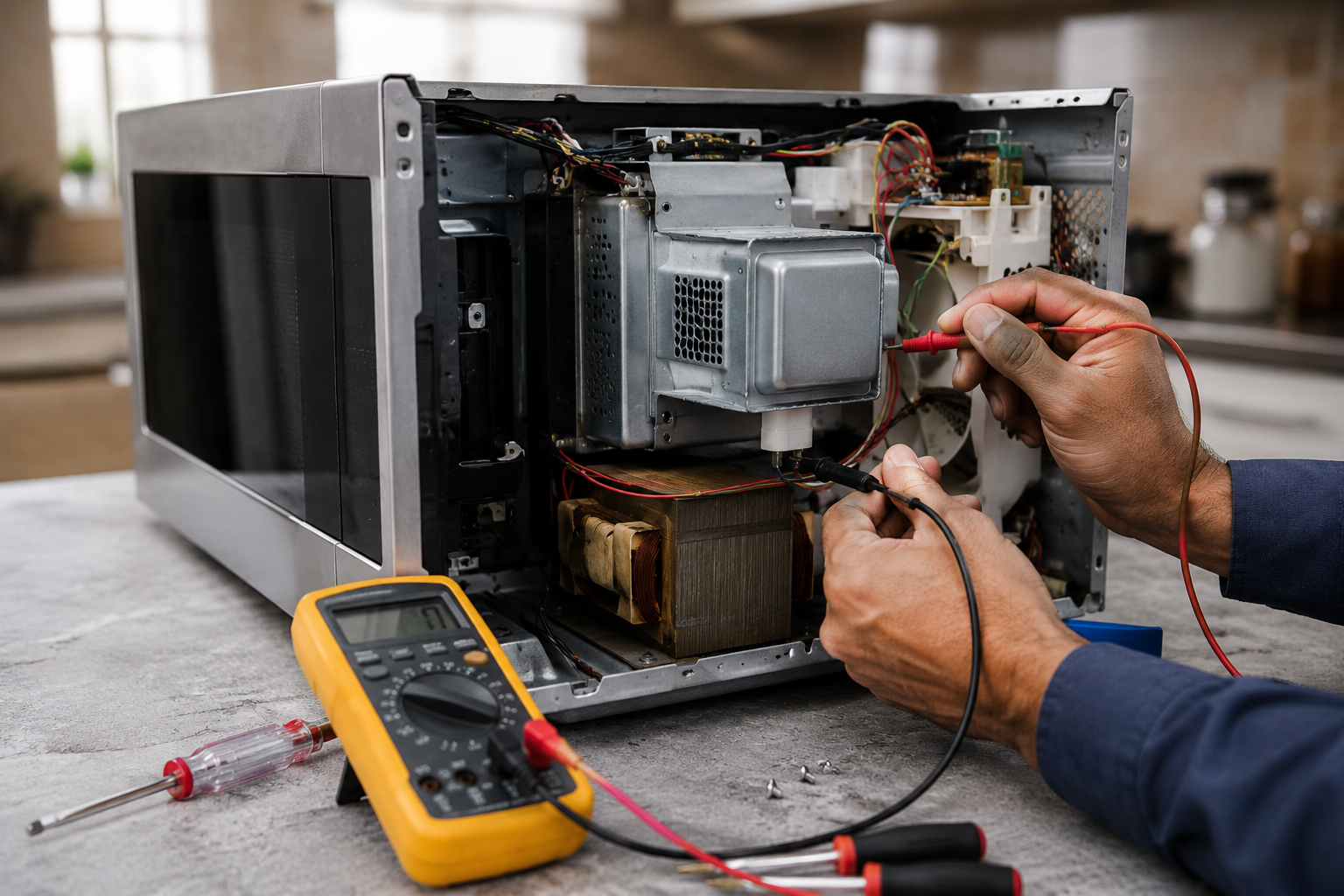
The microwave suddenly ceases to heat, ignites within, or doesn’t turn off could be an unimportant kitchen issue. The first thought of most people is to find solutions that are easy to DIY. However, the microwave repair technician is there for a reason: this appliance conceals extremely deadly components that can be found in any home device — a high-voltage capacitor that can carry the potential for a deadly electrical charge, even if the appliance was unplugged for several days.
This guide will explain exactly what a microwave repair technician’s job is to fix the issues that really need the help of a technician, what a typical service visit is like, and how you can expect to pay a qualified microwave repair technician can quickly identify whether the problem needs a simple adjustment or a professional repair high-voltage capacitor that can hold a lethal electrical charge even after the unit has been unplugged for days.
In fact, the U.S. Consumer Product Safety Commission has specifically warned against DIY microwave repairs due to the electrocution risk involved.
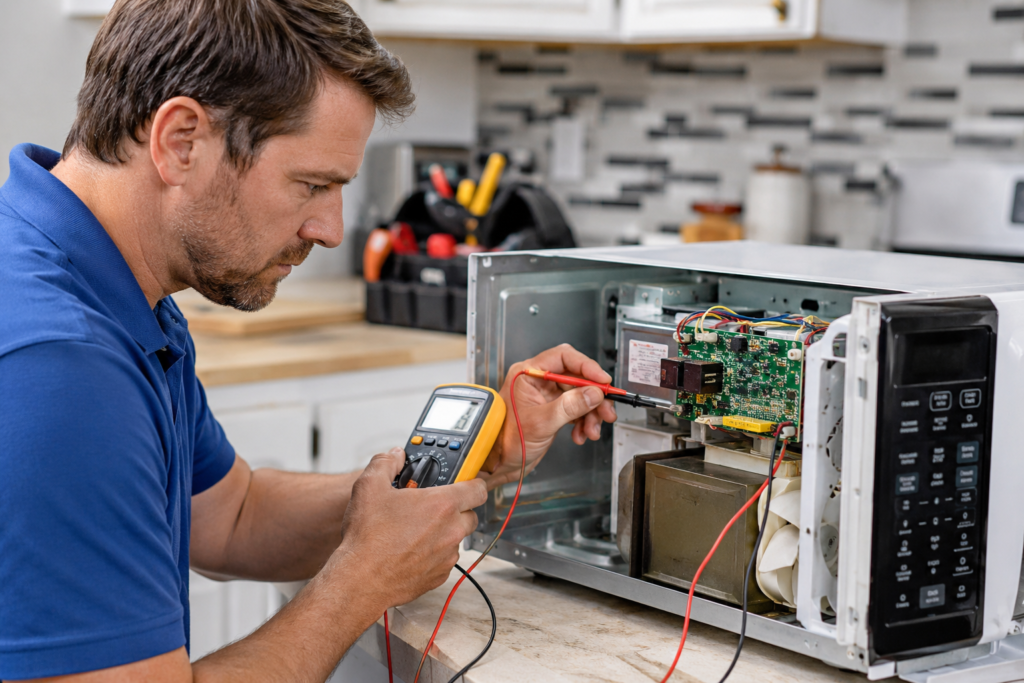
What Does a Microwave Repair Technician Do?
A technician for microwave repair is able to identify and fix problems within microwave ovens – countertop, over-the-range, and built-in models as well. Their work includes electronic components such as the magnetron and high-voltage capacitor, mechanical components such as the turntable motor, as well as control systems such as the control board and touchpad.
As opposed to a handyman who is a generalist, an engineer who regularly works with microwaves knows the precise safety protocols required for high-voltage components and is usually equipped with the appropriate replacement parts to fix common problems.and usually carries the right replacement components for common failures — something every good microwave repair technician should have ready.”
There isn’t a single certification required to be an expert in appliance repairs; however, trustworthy technicians usually have trade or manufacturer certificates. These are important because many manufacturers will only provide warranty service when repairs are completed by a trained technician who uses approved components.
Signs You Need a Professional, Not a DIY Fix
Certain microwaves are safe to test yourself. Some microwaves shouldn’t be opened without proper training. Here’s how to tell when you need a microwave repair technician versus a DIY fix:
- Secure to test yourself:
- The door is not closing completely because of an unbalanced or bent latch, or a bent hinge
- The turntable isn’t spinning because the guide roller or glass tray isn’t in its place.
- Small arc marks left by food debris (small, on the inside walls only)
- Displays that aren’t responding due to a tripped circuit breaker or an unconnected power source
- Requires a microwave repair technician:
- It’s turned on; however, it’s not cooking food (often due to an issue with the magnetron (or high-voltage diode)
- Humming, buzzing, or grinding sound effects are accompanied by a complete shutdown.
- Smoke, burning smell or visible sparks within the cavity
- Door that isn’t able to stay closed or has a damaged seal
- Touchpad that is not responsive has been connected with the controller board and not the display
- The unit won’t stop working, despite pressing stop or opening the door.
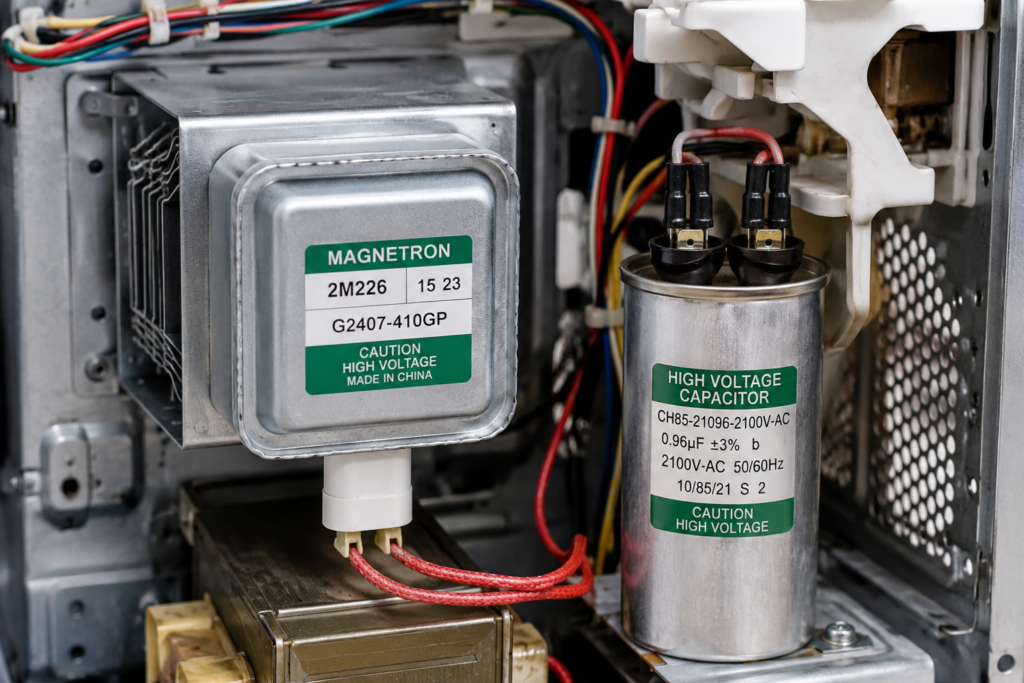
The most common thread is that any high-voltage component like a capacitor, diode, magnetron, or control board is located within the outer casing near the parts that contain a risky charge. This is the domain of a microwave repair technician it’s not a project for a weekend.
DIY-Safe or. Pro-Only: Quick Comparative
Use this table to quickly judge whether a microwave repair technician is truly necessary for your specific issue
Issue Can You Fix It Yourself? Why
| Turntable will not spin. | Often yes | Most often, it is a mechanical fix, either a tray guide or roller guides. |
| Door won’t latch | Sometimes | It’s dependent on whether it’s the hinge or latch switch assembly. |
| No heating, but the power is on. | No | Involves magnetron/high-voltage diode near the capacitor |
| Burning or sparking smell | No | Electrical fault risk, potential danger of fire |
| Touchpad not responding | No | It is usually a control board issue and not simply a reset. |
| Loud grinding/buzzing | No | A failing motor is often a capacitor under load. |
What Happens During a Repair Visit
An average service request follows a standardized pattern, regardless of whether you’re dealing with a countertop model or an integrated model.
- A review of the symptoms.
The technician asks what the microwave is doing (or not doing) and also any information about the model, brand, and the date of its purchase.
- A visual inspection.
Before opening anything, it is necessary to inspect the vents, doors, and the exterior for obvious damage.
- Disconnecting the plug and charge.
The device is shut off while the capacitor that is high voltage removed safely. This process should not be attempted without proper equipment.
- Diagnostic.
Using a multimeter along with other tools for diagnosing, technicians test components such as the magnetron, diode, fuses, and control board to identify the root of the problem.
- Replacement or repair.
Faulty parts are repaired or replaced. Over-the-range and built-in models typically require more time than countertop models due to the additional steps required to remove them.
- Evaluation.
The microwave is tested to ensure it is properly heated and shuts off in the manner expected before the technician departs.
The majority of repairs can be completed within a single visit, even though those who don’t have the exact part on hand may have to purchase it and then return it. A skilled microwave repair technician will always test the appliance carefully before completing the service.
Most visits also include a brief walkthrough of maintenance tips before the technician leaves — things like keeping the door seal clean, avoiding running the unit empty, and not slamming the door shut, since these small habits often extend the appliance’s working life well beyond its expected range. Homeowners who follow this basic upkeep tend to see far fewer repeat service calls over the following few years.
How Much Does a Microwave Repair Technician Cost?
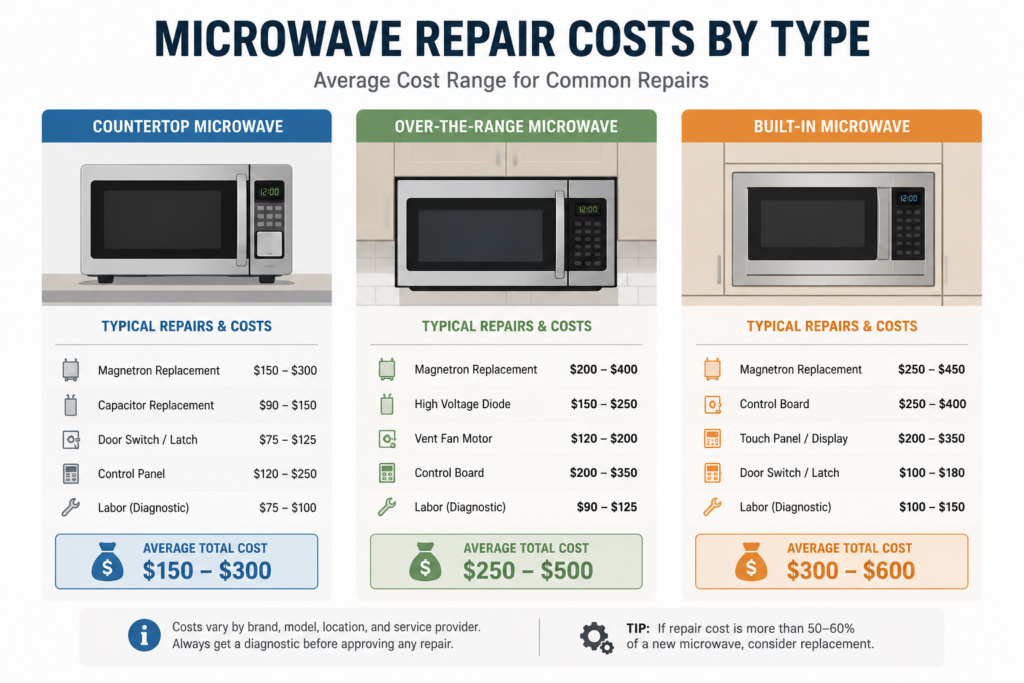
Repair costs vary based on the type of microwave as well as the part that has failed, and the local costs for labor. Here’s a breakdown of what a microwave repair technician typically charges by appliance type. This comparison makes it easy to see when calling a microwave repair technician is the safer choice:
Microwave Type Typical Repair Cost Range
| Countertop | $50 – $350 |
| Over-the-range | $50 – $500 |
| Built-in | $50 – $500 |
To top off fixing itself, anticipate:
- Diagnostic/service call fees:
roughly $75-$150, typically credited towards the repair if you decide to proceed
- Rate of labor:
typically $50-$150 per hour
- Parts:
tiny components such as the lightbulb could cost as low as $5, whereas an upgrade to a door or control board could cost $150-$300 or more.
In general, if the repair estimate is close to less than half of the cost of a new microwave, replacing it is typically the most sensible option — particularly in older models close to the end of a normal 8-10 year lifespan.
Costs can also shift depending on how easily parts are sourced. Older or discontinued models sometimes require special ordering, which can add a few days to the timeline and occasionally a small shipping fee on top of the standard part cost. Newer, more common models usually have parts available locally, keeping both cost and wait time lower.
Common Parts That Fail — and What Each Repair Involves
Understanding which component is likely at fault is something every microwave repair technician checks first:
Magnetron: This is the part responsible for generating the heat that cooks your food. When it fails, the unit typically still powers on, the turntable spins, and the display works normally — but the food stays cold. Replacing this component is one of the pricier repairs, since it often requires disassembling a large portion of the interior to access it safely which is why a microwave repair technician typically checks this part first.
High-Voltage Capacitor: This stores an electrical charge strong enough to cause serious injury, even days after the unit has been unplugged. It’s rarely the sole point of failure, but it’s almost always tested and discharged as a safety precaution any time a technician opens the unit — regardless of what the original complaint was.
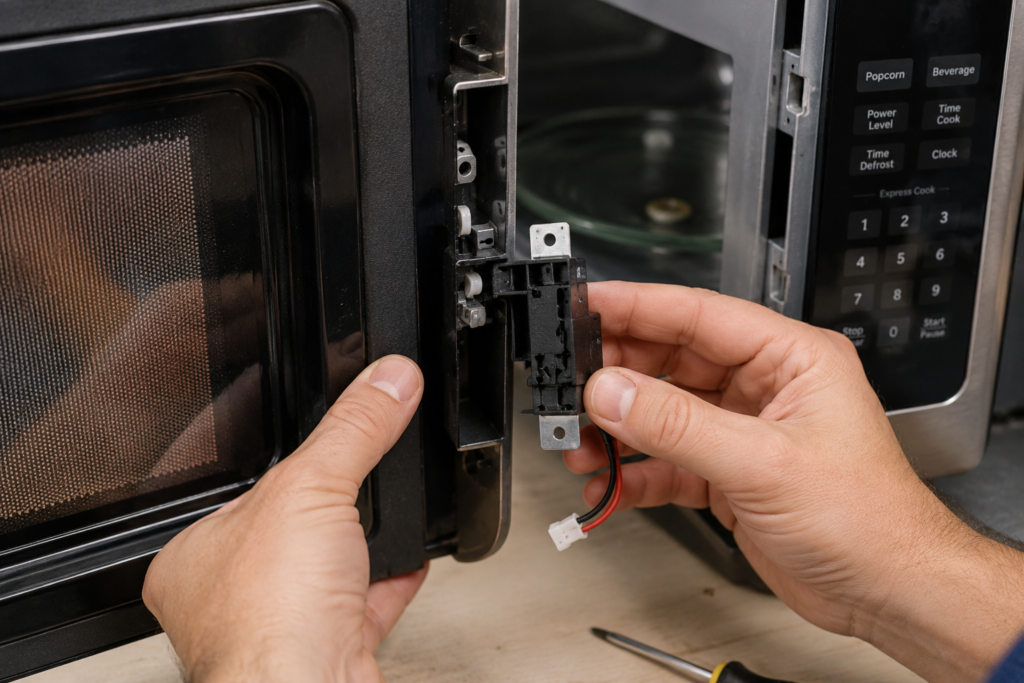
Door Switches: Most units have two or three small switches that confirm the door is fully closed before allowing power to the magnetron. A single faulty switch can prevent the unit from starting at all, even though this is one of the least expensive and quickest parts to swap out.
Control Board: This governs the touchpad, display, and timing functions. Water damage from spills, age-related wear, or power surges are the most common causes of failure. A dead touchpad with a functioning display (or vice versa) is a strong indicator that is the part at fault or a job best left to a trained microwave repair technician.
Turntable Motor: A small motor beneath the cavity floor rotates the glass tray. If the tray doesn’t spin but the microwave otherwise heats normally, this motor — or the coupler connecting it to the tray — is usually the cause, and it’s a low-cost, low-risk fix.
Diode: Working alongside the capacitor, this component helps convert electrical current into the form the magnetron needs. A failed diode often produces symptoms similar to a failed magnetron, which is why proper diagnostic testing matters — replacing the wrong part wastes both time and money.
How Long Do Microwave Repairs Typically Take to Schedule?
Scheduling time with a microwave repair technician varies by region and season.Availability varies by region and season. Countertop models are usually quick to service since they don’t require any wall or cabinet disassembly. Over-the-range and built-in units, on the other hand, sometimes need two people for safe removal and reinstallation, which can affect same-day availability.
During peak seasons — particularly around major holidays when kitchen appliances see heavier use — wait times for scheduling can stretch to several days. Booking as soon as symptoms appear, rather than waiting for the problem to worsen, generally means a shorter turnaround.
A Note on DIY Videos and Online Guides
Countless online videos claim to walk you through microwave repairs step by step. While some purely mechanical fixes (like adjusting a tray guide) are genuinely low-risk to follow, videos rarely emphasize just how dangerous the internal capacitor remains, even in a unit that’s been sitting unplugged for an extended period. Several documented injuries each year stem directly from attempts to open a microwave without first understanding — or safely discharging — this component. When in doubt, the safest approach is always to close the unit back up and call a professional. The safest approach is to call a microwave repair technician instead.
How to Choose a Reliable Microwave Repair Technician
A trustworthy microwave repair technician will happily walk you through all of these before starting any work. A few checks can go far in getting you through a repair without a hit:
- Request accreditation.
While not always legally mandatory, certified technicians are more likely to protect the manufacturer’s warranty.
- Make sure they have the correct instruments for diagnosing.
A multimeter and capacitor discharge tools are standard specifications for working safely.
- Look over reviews and the history of repairs.
Look for consistent reviews about timeliness, communication, as well as how long the repair lasted.
- Find out about the warranty of repairs themselves.
Reputable technicians typically back their work with warranties on parts and labor. Typically this is for 90 or longer days.
- Get an estimate in advance.
Clear, written pricing prior to work beginning can help avoid surprises.
Hiring an uncertified microwave repair technician to save money could result in a higher cost when it causes a breach of your manufacturer’s warranty or causes a recurrence of failure.The same repair-vs-replace logic applies to other kitchen appliances too — if you’re dealing with oven issues as well, our guide to common gas oven problems and how to fix them walks through the same kind of decision-making.

Repair or Replace? A Simple Framework
A microwave repair technician can help you weigh these four questions. Be sure to ask these questions prior to committing to hiring a microwave repair technician .A microwave repair technician can usually give you a quick read on which of these applies:
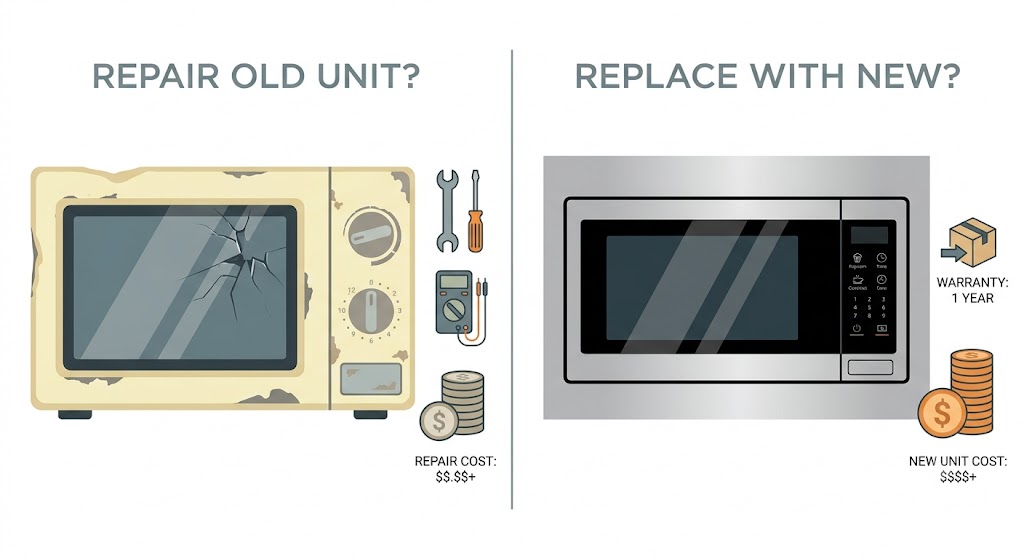
1.Are the repair costs estimated to be higher than half the new microwave’s cost?
Consider replacing the microwave.
2.Are the units less than five years old?
Repairs are usually worth it.
3.Did this exact appliance fail several times over the last year?
It is possible to replace it and save money in the long run.
4. Is the problem just mechanical or cosmetic (tray or doors latch)?
It is almost always worth fixing.
Frequently Asked Questions
1.Are I need assistance from a trained technician who has the right knowledge to fix your microwave?
Hiring a certified technician isn’t legally required; however, it will help you protect warranties with manufacturers and decrease the risk of repairs.
2.Can I fix an appliance on my own?
Simple mechanical issues such as a jammed tray or door that isn’t aligned are usually safe to examine. An expert should handle anything that involves the magnetron, capacitor, or control board because of the danger from electric shock.
3.What is the length of time the typical microwave repair time?
A microwave repair technician typically completes most repairs in one visit. Most repairs are done in one visit, which is usually less than one hour, although the built-in models and repairs that require parts made-to-order may be more difficult to complete.
4.What does it usually cost to fix microwaves?
The majority of microwave repair technician cost between $100 and $350 according to the part needed and the microwave type, along with the diagnostic cost, which is typically credited to the final price.
5.Does an DIY repair invalidate the warranty on my microwave?
In many instances, it’s often the case. Repairs for manufacturers are usually required to be performed by a certified microwave repair technician with approved parts to keep the warranty in place.
6.What is the most appropriate time to upgrade my microwave, rather than fix the issue?
If the repair price is around one-third the price of a new appliance, or your microwave has been in excellent working order and has failed several times, replacement is generally the most cost-effective option.
7.What equipment should technicians who work on microwave repairs use?
Technicians typically use a multimeter for electrical testing, a discharge tool for capacitors to protect themselves, and a few simple hand tools to disassemble and replace parts.
At the end of the day, a working microwave is one of those conveniences most households don’t think about until it stops functioning. Taking a few minutes to understand the warning signs above can save both time and unnecessary repair costs down the line
Conclusion
Repair technicians for microwaves do more than swap out parts a reliable microwave repair technician focuses on safety, accurate diagnosis, and long-term solutions. In short, a microwave repair technician is worth calling whenever safety or warranty is on the line. They manage one of the very few household appliances that can be a real risk to safety in the event of an untrained user opening it .A professional microwave repair technician ensures the repair is completed safely and correctly.
Knowing what issues are safe to look into yourself, the details of the actual process of repairing, along with what a reasonable cost will put you in a better situation, regardless of whether you decide to seek out a professional’s help or want to know the cost of repairs.