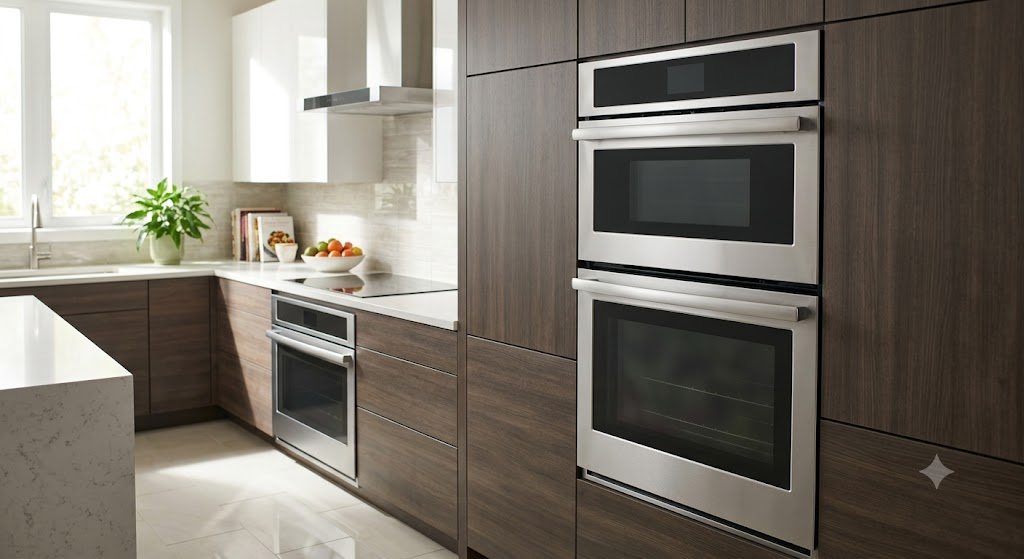
Microwave ovens built are cluttered or you’re planning a remodel that requires an organized look, microwave ovens that are built directly into cabinetry are a solution that most homeowners choose. In lieu of occupying space, the appliance disappears into the wall, an island, or a lower cabinet; the kitchen will end with a look that is more reminiscent of an individual build rather than an array of kitchen appliances.
The trick isn’t deciding on one; it’s choosing the right size and style for the cabinet you’re planning to install. If you purchase the wrong cutout, you’re either having to return it or paying a carpenter to fix an error that a five-minute measurement could have prevented. This guide will walk you through the various types offered, the most popular models available with currently, sizes, the rules for sizing, and the actual costs.
No matter if you’re undertaking a total kitchen renovation or just replacing an appliance that’s handed over, the choices will be the same: what type of appliance is best suited to how you cook, if the existing cutout is working or requires a change or a new one, and the amount you’re willing to spend after installation has been added over the price of the sticker.
What Counts as a Built-In Microwave
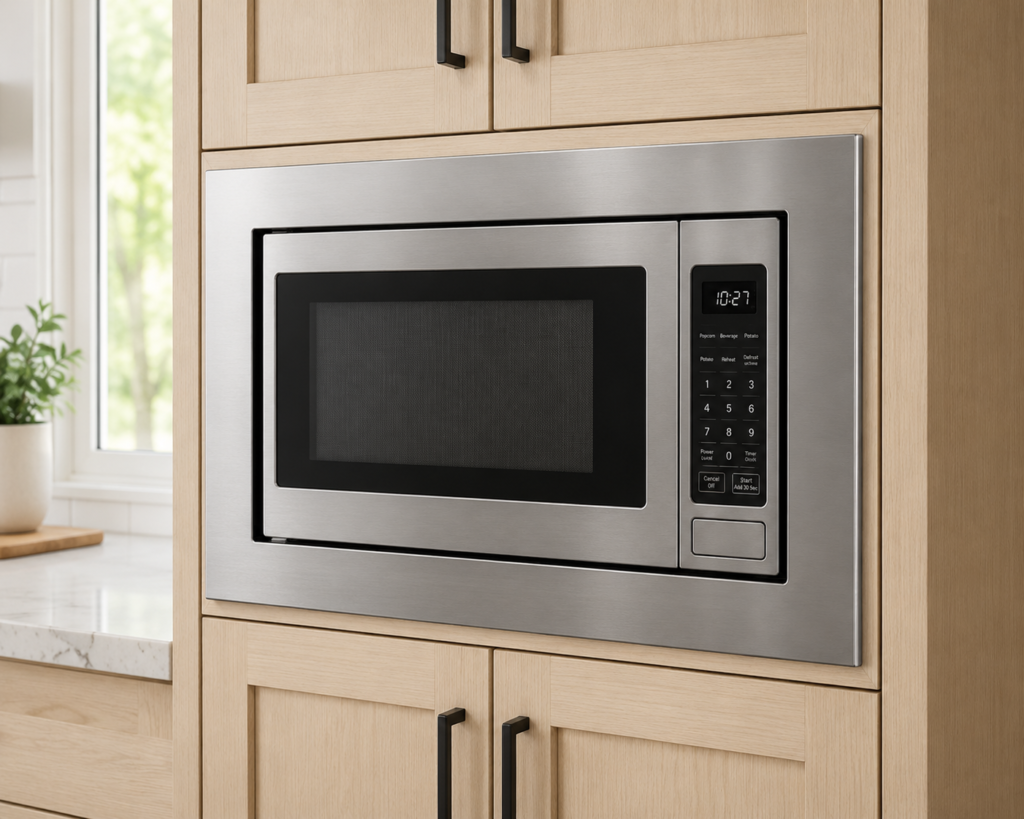
Microwave ovens built for cabinetry are designed to sit permanently within a wall, doorway, or island — not on the countertop. A built-in microwave is an appliance that is designed to be permanently within cabinetry, a doorway, or on an island — not the countertop. It is secured with the trim kit, which seals the space between it and the cabinet, creating an attractive, flush appearance.
It’s more crucial than it appears it ought to be. Countertop microwaves don’t have the same heat-clearance or venting design as built-in models; therefore, using them as a built-in microwave isn’t just in violation of the manual; it’s a real fire hazard. If you’re searching microwave ovens built for cabinetry, then the product description must include built-in specifically.
The Three Main Types
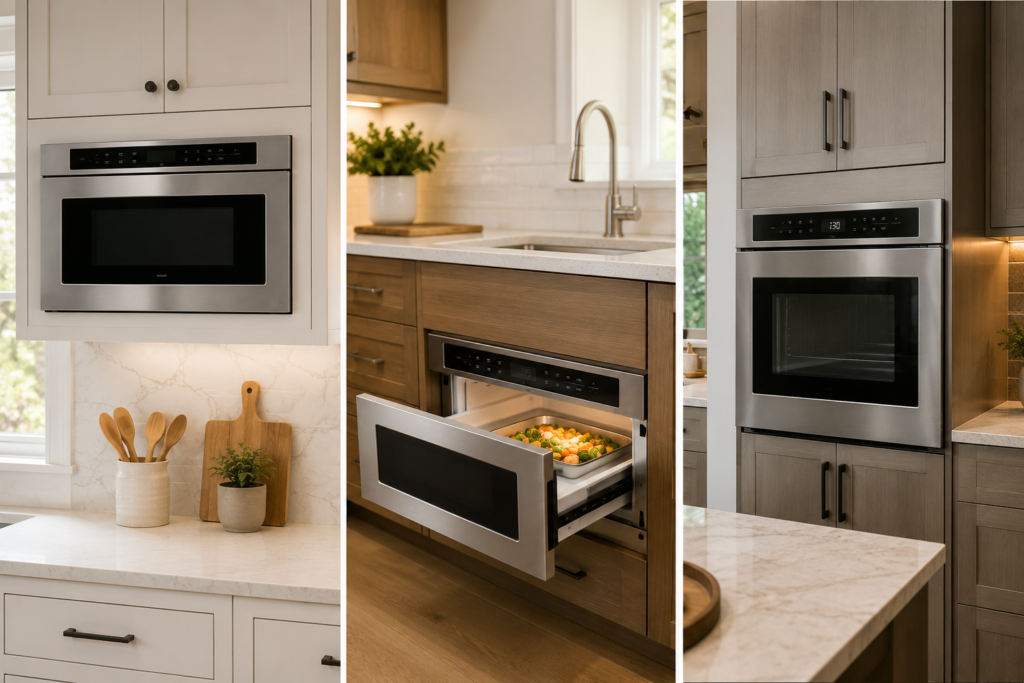
There are three main categories of microwave ovens built for cabinetry, each suited to a different kitchen layout.
1.Built-in wall units
The built-in units are located at eye level, typically just below or next to an oven on the wall, which has doors that swing open or slide down. They’re the most compatible option when you already own an oven in your wall, and you want both appliances to appear as if they’re a matching pair.
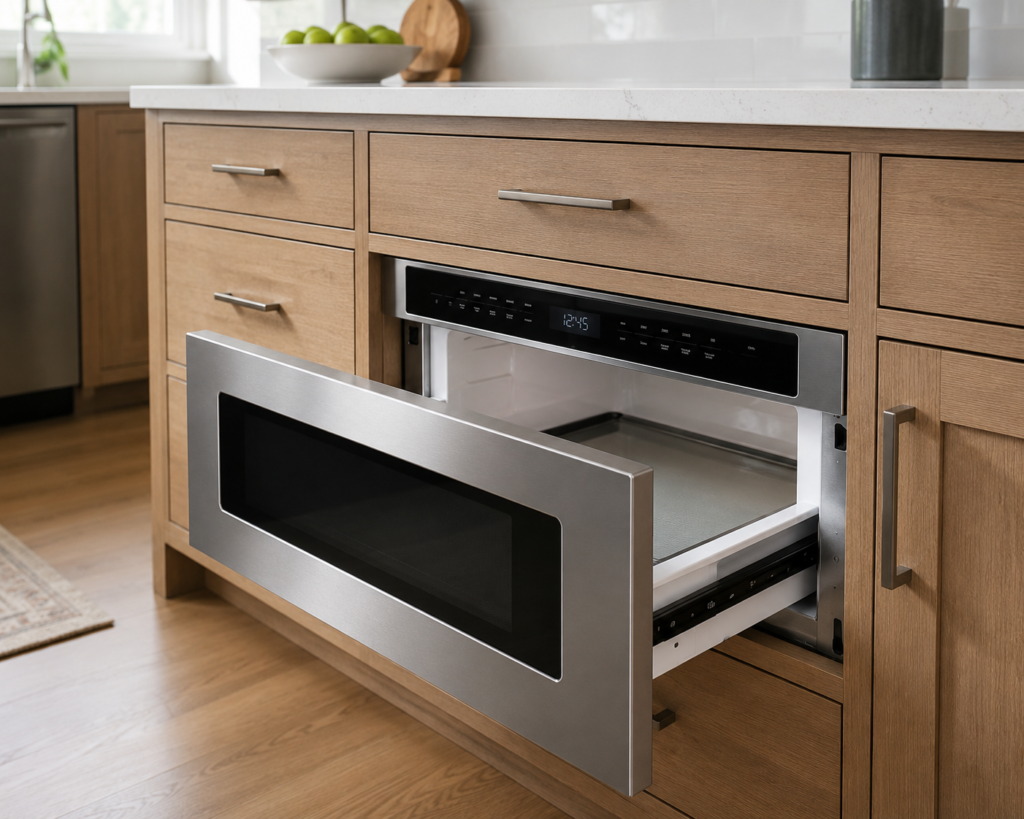
2.Drawer microwaves
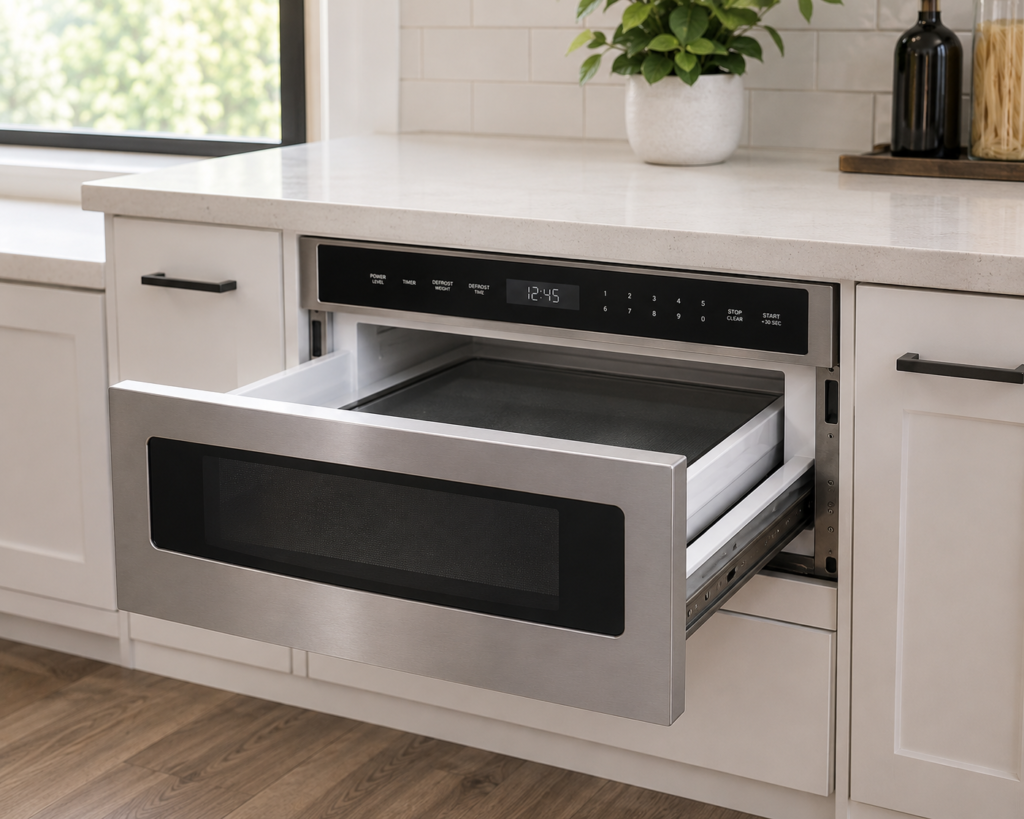
Microwaves for drawers are installed inside lower cabinets and are opened by pulling the entire unit out, just like the drawer in your dishwasher. Since you’re lifting dishes upwards and out, instead of moving them towards you over an unlocked doorway, they’re an ideal choice for families with children or anyone who is exhausted of having to balance hot plates across an open door that swings.
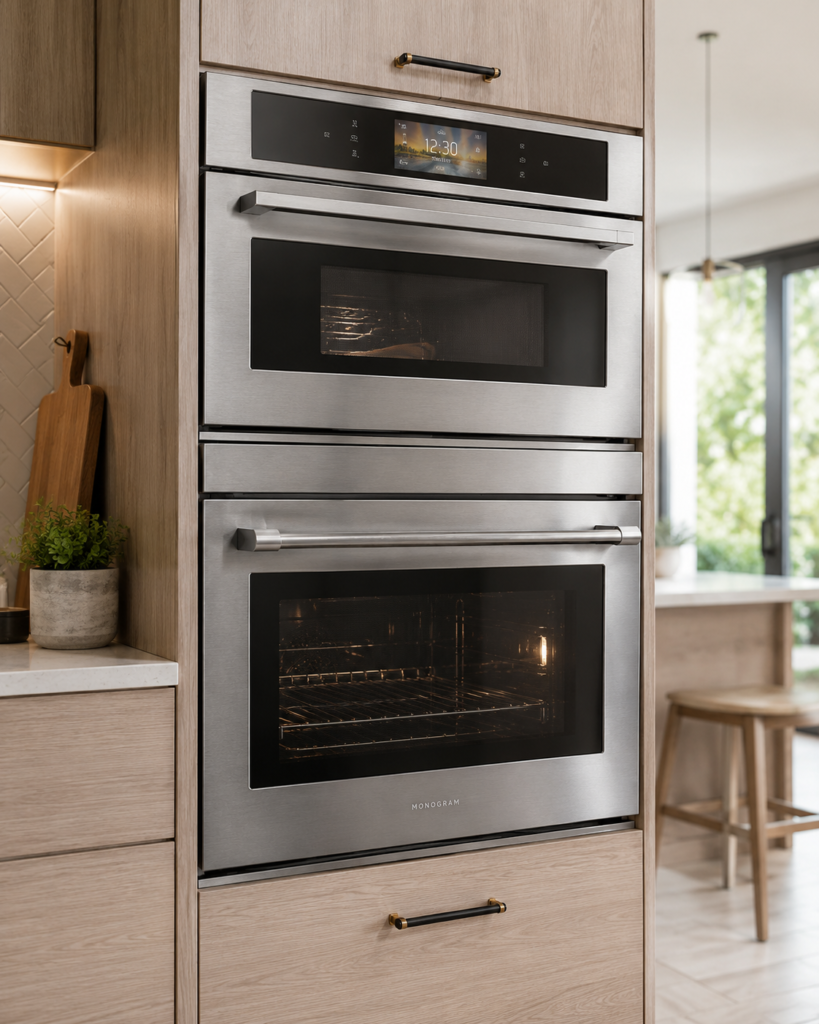
3.Convection combination units
Convection combination units serve as a microwave and a small oven within one space. They are usually equipped with broil or air fry settings. They’re an excellent choice for kitchens with smaller spaces in which a full oven isn’t necessary you’ll require more than just power for reheating.
The over-the-range (OTR) microwaves can be built-in as well; they are installed above the stove, and they can also be used as a vent hood and have different clearance requirements than cabinet-installed units.
Pros and Cons of Each Type
Being aware of the trade-offs prior to you buy microwave ovens built for cabinetry saves you from the hassle of a return later.
Wall units with built-ins
- Pros: It matches the design of the wall oven, is at a comfortable eye level, and it is easier to unload and load.
- Cons: Usually, the most costly to set up; requires a dedicated cabinet for running.
Microwaves in the drawer
- Pros: Safer for large dishes as you can lift instead of reaching across, a height that is suitable for children, and sleek design with no obvious door swing.
- Cons: A little less capacity for use in certain models, and installation requires exact leveling.
Convection combo units
- Pros: It can also be used in the capacity of an oven. This is perfect for kitchens that do not have enough space for another oven of a large size. It is usually served with an air-fry or broil.
- Cons : More powerful models that perform faster when convection is on. Typically, they are more expensive than microwaves that only work. Convection combo microwave ovens built for smaller kitchens tend to run warmer during convection mode.
Over-the-range units
- Pros: It combines microwave and range hood in one space, without the need for separate cabinets
- Cons: Venting and ducting specifications are more strict, while the height over the range is determined by code and can’t be altered
That covers the main microwave ovens built options available today.
8 Best Microwave Ovens Built for Kitchens Right Now
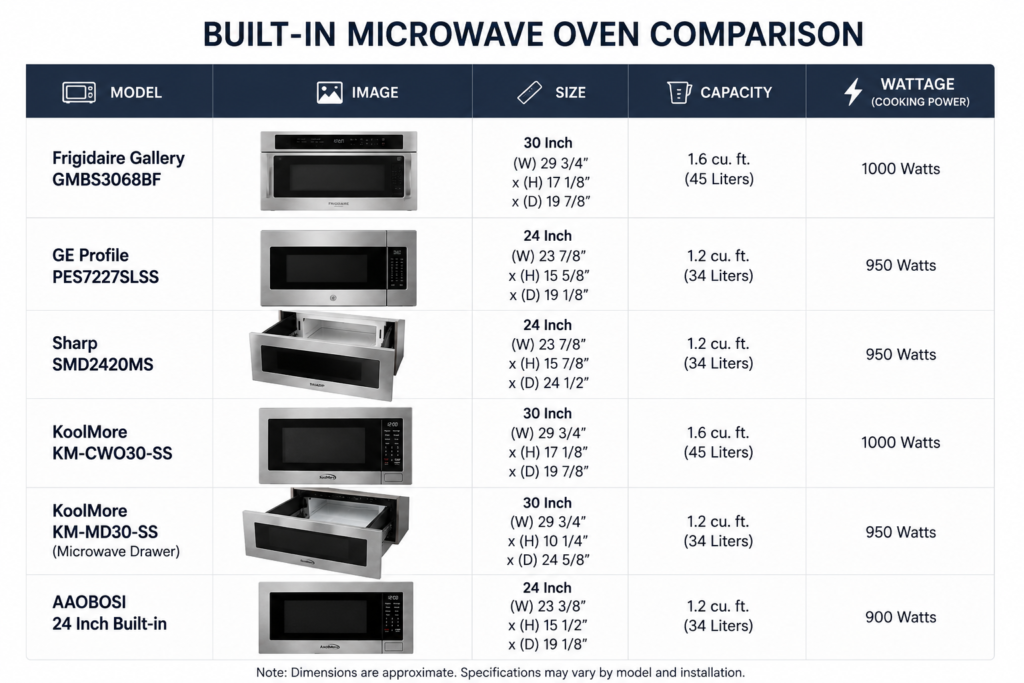
Here are the microwave ovens built for kitchens that are selling well right now that covers the main microwave ovens built options available today.
1. ZLINE 24” Built-In Convection Microwave
Available in stainless, black stainless, and ZLINE’s fingerprint-resistant DuraSnow finish, with sensor cooking and roughly 1.5 cu. ft. of interior space. It is available in 24” and 30” cutout dimensions, making this one of the most flexible options when you’re not certain of the width you’ll end up getting. This makes it one of the simpler microwave ovens built for cabinetry to install correctly.
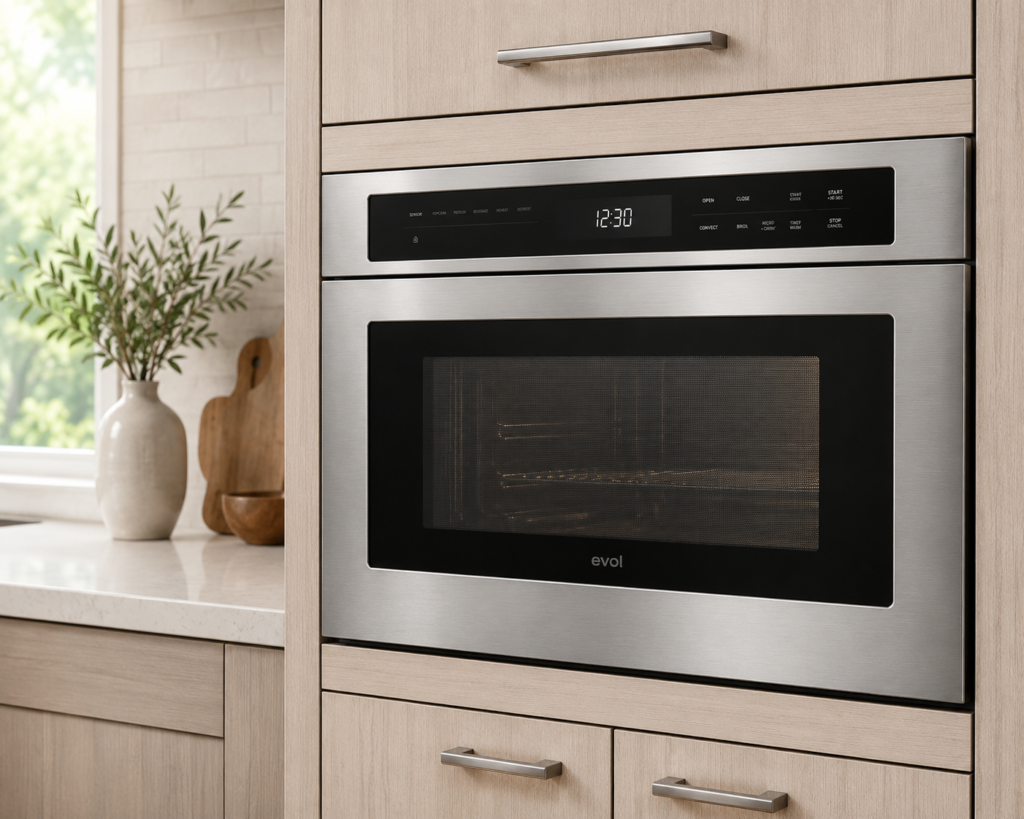
2.Sharp SMD2470ASY Microwave Drawer Oven
A 1.2 cu. feet. drawer model that has a concealed control panel and Sensor Cook technology. It is ideal for buyers who are looking to free up space in the lower cabinets but are unable to put in an appliance that is wall-mounted. This makes it one of the simpler microwave ovens built for cabinetry to install correctly.
3.KoolMore 24” Convection Oven and Microwave Combo
Combines broil and convection heating along with a soft-close door as well as an LCD touch display. The perfect choice when you’re looking for oven-style baking without sacrificing a full run of the cabinet. This makes it one of the simpler microwave ovens built for cabinetry to install correctly.
4.Summit SMBI24 Built-in Microwave with Trim Kit
A 1.2 cu. feet. model that comes complete with trim kits, making installation easier and more reliable than models that need you to purchase a trim kit separately. This makes it one of the simpler microwave ovens built for cabinetry to install correctly.
5.ThermoMate 24” Built-in Microwave Drawer
1000W, with 11 levels of power and touchscreen controls. It’s priced at a lower cost than many drawers — an acceptable choice for those with a budget as the main element. This makes it one of the simpler microwave ovens built for cabinetry to install correctly.
6.Cosmo COS-12MWDSS NH Haven Collection Drawer Microwave
24” drawer unit that has touch controls as well as an included defrost rack. It is in the middle of the price range with a solid warranty backing. This makes it one of the simpler microwave ovens built for cabinetry to install correctly.
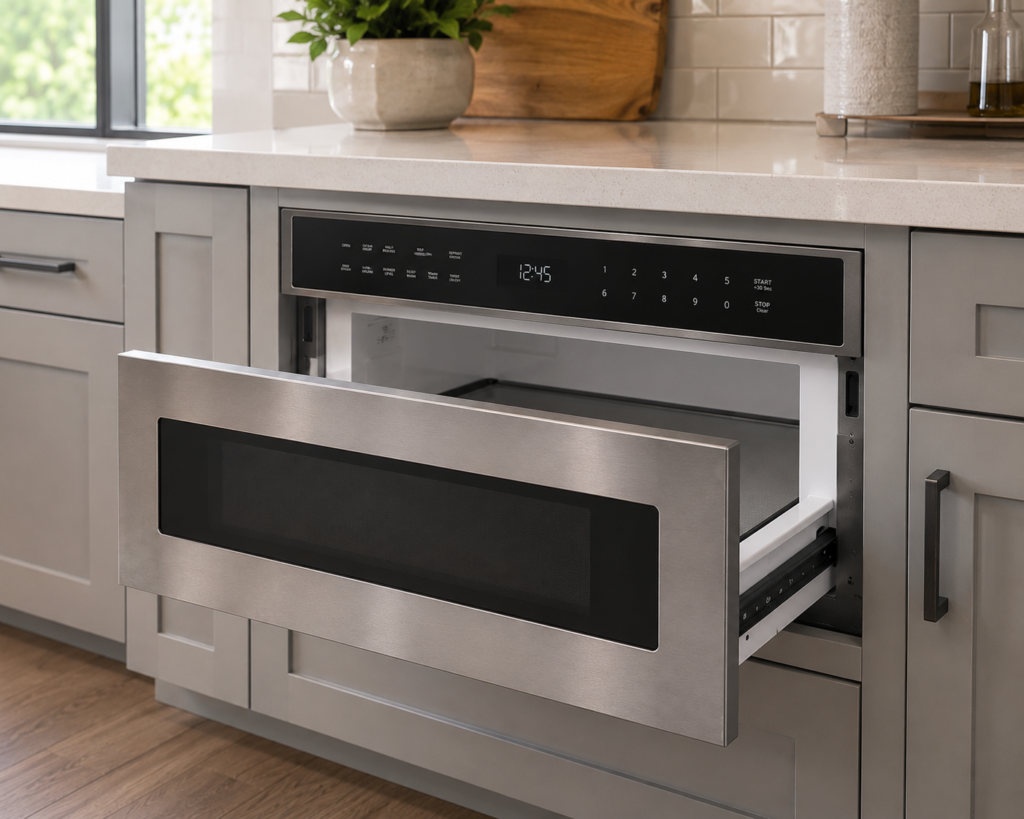
7. GASLAND 24″ Built-In Convection Combo
1.6 cu. feet. of space inside with 11 power levels as well as a drop-down door, one of the bigger capacity combinations for larger families. This makes it one of the simpler microwave ovens built for cabinetry to install correctly.
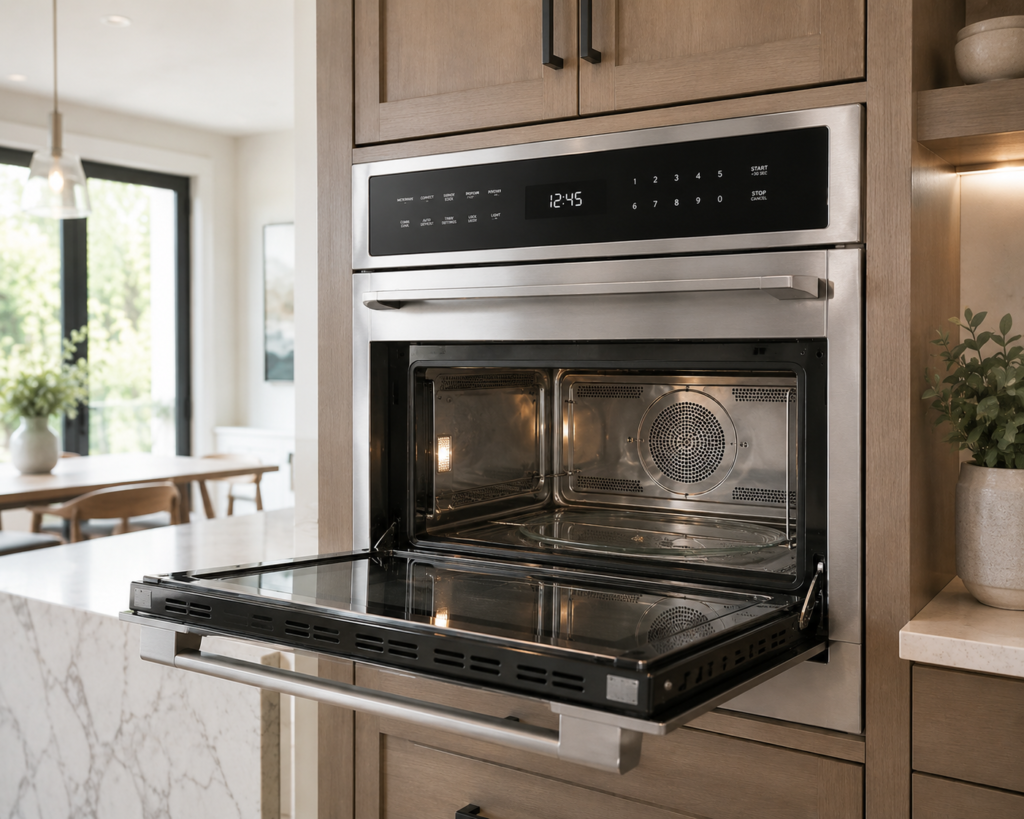
8.FORNO 24” Built-in Microwave Oven
A 1.6 cu. feet. Convection oven that has a top broiler as well as a stainless interior. It is designed for customers who bake often and desire a better oven experience within the space of the microwave. This makes it one of the simpler microwave ovens built for cabinetry to install correctly.
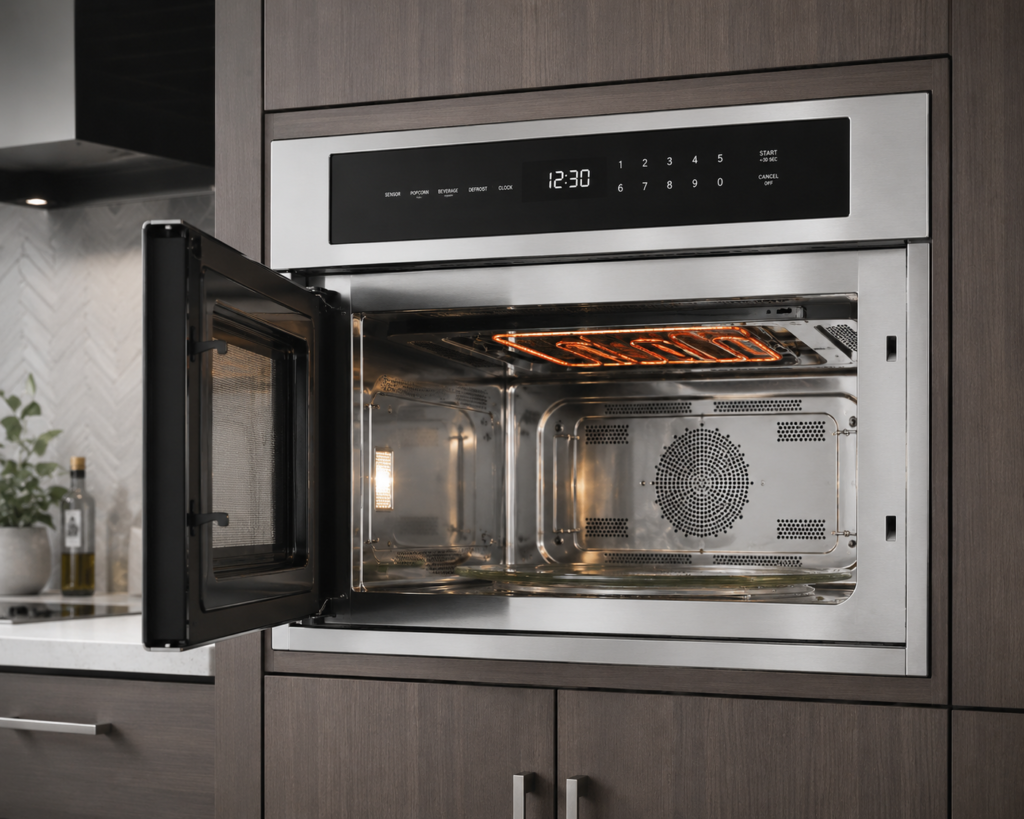
Comparison Table
Prices for these microwave ovens built for kitchens change with promotions, so treat the $ symbols as relative rather than fixed.
| Model | Type | Capacity | Cutout Width | Price Range |
| ZLINE 24” Built-In Convection | Built-in wall | 1.5+ cu. ft. | 24”/30” | $$$ |
| Sharp SMD2470ASY | Drawer | 1.2 cu. ft. | 24” | $$ |
| KoolMore KM-CWO24-SS | Combo | 1.6 cu. ft. | 24” | $$ |
| Summit SMBI24 | Built-in (trim kit incl.) | 1.2 cu. ft. | 24” | $$ |
| Thermo Mate Drawer | Drawer | 1.2 cu. ft. | 24” | $ |
| Cosmo COS-12MWDSS-NH Drawer | Drawer | 1.2 cu. ft. | 24” | $$ |
| GASLAND Combo | Combo | 1.6 cu. ft. | 24” | $$ |
| FORNO Built-In | Built-in wall | 1.6 cu. ft. | 24” | $$$ |
Prices change in response to promotions, so consider the symbols of $ as not fixed numbers but rather as a relative representation. Check the current list before you buy.
Built-In as opposed to. Countertop: Is the switch worth it?
Deciding between microwave ovens built for cabinetry and a plain countertop unit comes down to space and budget. If you’re not sure whether or not to build-in in the first place, it all comes down to the extent you’re looking for in counter space versus the amount you’re willing to pay in the beginning.
A countertop microwave is cheaper than a microwave that requires installation and is able to be replaced within a matter of minutes should it break. This makes it a practical choice for people renting, living in tiny apartments, or any other person who’s not planning a major renovation.
A built-in appliance is more expensive in both purchase and installation, but it frees the counter space for a long time and gives your kitchen a more polished, cohesive appearance. This is especially important when you’re remodeling with the intention of selling. The listings for real estate and guides to kitchen remodeling consider built-in appliances to be a middle-to-upper-tier kitchen item, which is why this type of appliance has grown in conjunction with larger kitchen renovations.
If you’re looking at resale values specifically, a microwave with a built-in oven along with a wall oven can be read as a more thoughtful style choice than a countertop unit that is near a stove; however, it’s not a purchase that is able to pay for itself, the way the kitchen’s cabinets or countertops could.
Sizing: What Cutout Do You Actually Need
Most microwave ovens built for kitchens are sized around 24, 27, or 30 inch cabinet openings. The majority of microwaves oven built made specifically for kitchens are designed around the 24”, 27”, or 30” openings in the cabinet, however “24 inch” does not guarantee compatibility among brands. KitchenAid’s installation specifications for instance, calls for an opening that’s 28 1/2” wide, 17 5/8 “high and at least 21 7/8 “deep, with clearance above and below — dimensions that don’t necessarily match a different brand’s 24” model.
Before placing an order for anything:
- Take measurements of the width, height, and the depth of the cutout, not only the cabinet’s dimensions.
- Make sure the model is equipped with the trim kit, or needs an additional purchase.
- Check the electrical requirements of the model. Certain convection combinations require a 24V circuit instead of the standard 120V outlet.
- Make more than one measurement and take measurements at various places. Older cabinets aren’t always square. Even a cutout that appears perfect on the top may be a half-inch wider on the lower end.
What Installation Actually Costs
Installing microwave ovens built into cabinetry typically costs more than a countertop swap. This is the place where most of the sticker shock takes place since the price of the unit is only a small portion of it.
- Trim kit flush installations generally cost between $220 and $580 for materials and labor.
- The installation of microwaves in drawers costs between $255 and $430 for labor in addition to a $1,000-$2,000 unit cost for more expensive drawer models.
- Modification to the cabinet. Costs for microwave ovens built into cabinetry go up quickly once carpentry or wiring changes are involved. In the event that your existing cutout isn’t compatible with the new cutout, you’ll need to pay an additional $40-$80 per hour of carpentry.
- The electrical work, like the addition of an outlet, as well as a separate circuit, could cost anywhere from $150 to $600.
DIY installations are feasible for swapping out the same size replacement without modifications to the cabinet or wiring. Anything that requires microwave oven built cutting cabinetry or working with electrical wiring is best left to an expert — the price of a wrong installation (a damaged cutout, or an overheated device due to bad clearance) typically outweighs the expense of labor that you’re trying to avoid. DIY works for these microwave ovens built into cabinetry only when it’s a same-size swap
Mistakes That Lead to Returns and Rework
A few recurring mistakes account for most of the returns and rework with microwave ovens built into cabinetry:
- A countertop microwave is purchased and then trying to install it as a built-in; the microwave isn’t rated for this and poses the risk of fire.
- The measurement of width, but not the depth, only to find that it doesn’t completely clear the cabinet’s back.
- Assuming that two brands’ “24 inch” models can be interchanged if depth and height differ
- The mistake of not checking if it is included prior to the checkout process, only to be the unexpected second purchase
- The cheapest option is not having a look at the electrical specifications before contacting an electrician during the installation.
Avoiding these mistakes with microwave ovens built for cabinetry saves both money and time. Most of these issues with microwave ovens built into cabinetry are avoidable with careful measuring.
Keeping a Built-In Microwave Running Longer
Microwave ovens built into cabinetry need a bit more upkeep than countertop models. These microwave ovens built into cabinetry are harder to swap out than a countertop unit, so a little upkeep goes further. Built-in units are more difficult to replace than a countertop unit. A little care is more important.
- Clean the area after spills, rather than letting them bake — food residues that have been trapped are among the most frequent reasons for inconsistency in heating over time.
- Make sure the door seal is checked every couple of months. A worn or damaged seal lets steam and heat escape and forces the unit to be more prone to
- Replace or clean the charcoal filter on convection combination models as per the manufacturer’s schedule, as a blocked filter will affect both airflow and the performance of cooking.
- Do not run the unit without food or cooking equipment made of metal, as this is a typical reason for arcing and damage to the control panel.
- If the drawer or turntable mechanism becomes stuck, look for any debris on the track prior to assuming that the issue is a motor problem.
If you need anything more than the basic cleaning or maintenance, the microwave oven repair technician’s guide will help you troubleshoot your microwave before you contact an expert.
Buying Checklist Before You Order
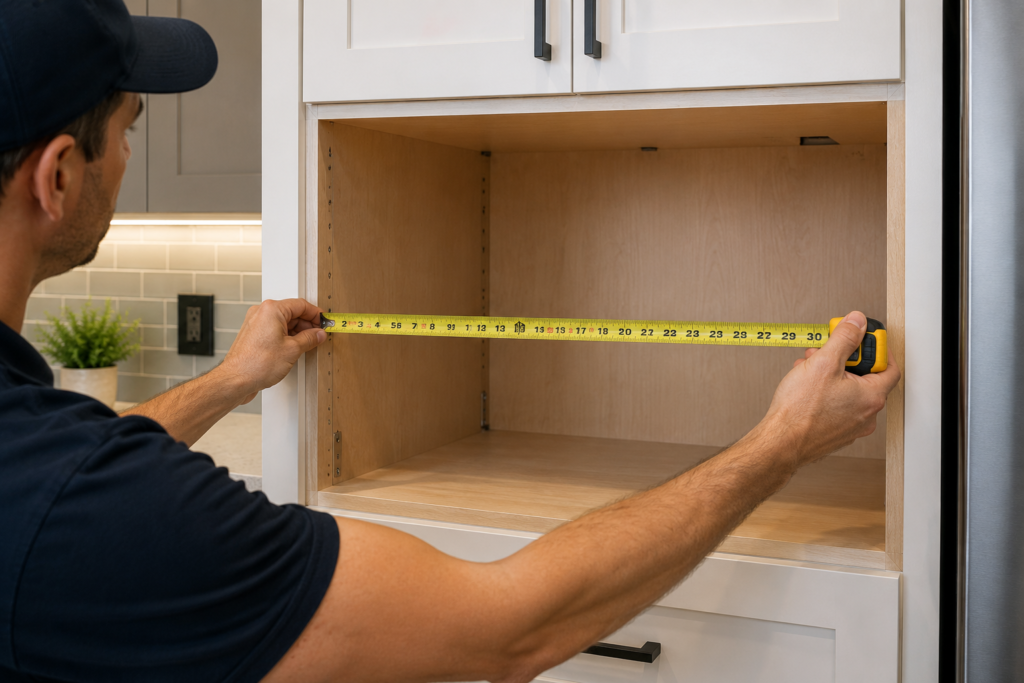
Run through this checklist before ordering any of these microwave ovens built for cabinetry. Go through this process before you add any items to your shopping cart.
1.The cabinet cutout’s dimensions are measured in length, width, and depth at a variety of points.
2.Find out if your model comes with a trim kit, or if you have to buy the trim kit on your own.
3.Be sure to meet the proper electrical requirements, whether an outlet that is 120V, which is common or an 240V circuit that is specifically designed for.
4.There are drawers, wall-mounted or convection options based the method you cook with
5.Check the capacity of your interior against cooking and food items you use the most.
6.Check out recent reviews of buyers for any recurring complaints regarding the door mechanism, turntable, or the control panel.
7.Consider the installation cost, which is not just the cost of the unit, before making a budget.
Following this checklist keeps your microwave ovens built purchase mistake-free.
Frequently Asked Questions
1.What size of cabinet do need to accommodate the microwave?
Most microwave ovens built for cabinetry are sized around 24, 27, or 30 inch cutouts. However, always confirm the exact dimensions of depth and height prior to placing an order. The width of a piece does not guarantee a perfect fit. This is true for nearly all microwave ovens built for standard cabinetry.
2.Do I have to install an appliance on a countertop as an integrated unit?
No. Countertop microwaves don’t have vents or mount designs for cabinets, and putting one in this manner is an actual danger of fire.
3.Does a built-in microwave really worth the price?
In the majority of remodels, microwave ovens built into cabinetry are worth the extra cost the answer is a resounding yes. It helps to free up counter space and makes the kitchen a more polished and integrated appearance, but it’s more expensive in the beginning than the countertop model.
4.Do all microwaves designed to work in 24” spaces include the trim kit?
Not always. Certain models, such as those in the Summit SMBI24, include it, and others will sell the trim kit separately. So be sure to check the list before purchasing.
5.What will it cost to set up a built-in oven?
The price of installing a trim kit is usually between $220 and $580, with more in the event you need to make changes to the cabinet or a modification to electrical systems is required.
6.Is there a difference between a microwave that is in the drawer or a wall unit that has a built-in microwave?
A microwave drawer is a microwave oven built that can be placed within a cabinet. It can be accessed by pulling it open. An integrated wall unit is higher and comes with an opening that swings or doors that drop down.
7.Do built-in microwaves require special wiring?
Certain models of convection have an electrical connection of more than an ordinary outlet, so it’s worth checking the spec sheet before installation day.
8.What is the length of time for installing an in-built microwave?
A similar-to-like swap using an identical cutout can take anywhere from 1 to 3 hours. Anything that requires modifications in the electrical or microwave ovens built into cabinet might need more time.
9.Do I have to install an in-built microwave by myself?
If you’re replacing an older model with the same dimensions and where no electrical adjustments are required, DIY is an option for those who feel comfortable working using basic tools. If the task requires cutting cabinets or carrying out wiring that isn’t yet in place, it is suggested to employ experts. A poorly sealed trim kit or a misplaced clearance could compromise the efficiency and security.
10.Why are built-in microwaves priced at a an expense that is higher as compared to countertop units?
The most expensive cost is the microwave because microwaves built into them have different requirements regarding heat clearance and venting.. The remainder comes from installation, trim kits, and precise cabinet fitting, and even electrical tasks that a countertop microwave rarely requires.
Conclusion
The choice of the best microwave oven made for your kitchen boils down to three options: which one is best suited to your kitchen layout, such as cabinet, wall, or combination — and whether your cutouts match the actual specifications of the model and whether your electrical system will be able to handle the work.Choosing the right microwave ovens built for your kitchen comes down to three decisions. Measure first before choosing any microwave ovens built for your kitchen.If your existing unit is in place and has been causing you problems, our microwave repair technician’s guide to the oven will cover the most commonly used fixes before you choose to upgrade it.